PLA Plus vs Regular PLA Explained: What the Plus Buys
PLA+ trades stiffness and a little tensile strength for 5 to 12 times the impact toughness. Data-sheet numbers, the settings to change, and how to check.
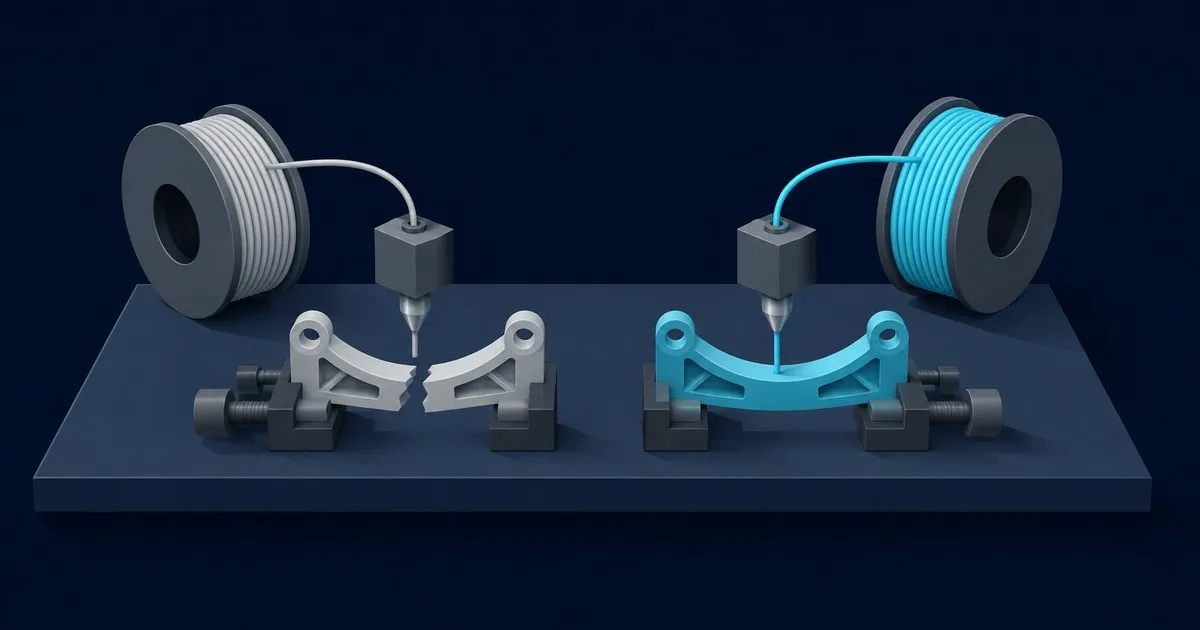
PLA+ is regular PLA with an impact modifier compounded in, sold under a name no standard defines. The plus buys toughness: on the data sheets below, notched impact strength rises five to twelve times over the same brand’s plain PLA, while tensile strength stays flat or drops and stiffness falls. It does not buy heat resistance. This is PLA plus vs regular PLA explained from the data sheets and one independent test, with the settings that change and a way to verify them on your own printer.
What the plus actually means
Prusa’s PLA page describes the base material as brittle and inflexible, breaking along layers or into shards on impact, with weaker layer adhesion than other materials. PLA+ exists to fix that, and each vendor’s recipe is proprietary.
Blending PLA with an elastomer is the usual route. In a 2021 Polymers study, pure PLA broke at 4.5% elongation with a notched impact strength of 3.9 kJ/m², and a 15 wt% silicone polyurethane blend reached 22.3% and 19.3 kJ/m². CNC Kitchen found the same pattern in Polymaker’s safety data sheets: PolyMax PLA contains “a significant amount of ‘Acrylic Polymers’” while PolyLite PLA “is basically only PLA with only a minor amount of additives”. Rubbery domains absorb crack energy and cost stiffness, the trade in every row below.
The data-sheet comparison
Polymaker and Bambu publish comparable sheets for a plain and a toughened PLA: X-Y typical values, notched Charpy to ISO 179, linked under Sources. eSUN quotes IZOD, which does not compare, so its PLA+ appears only in the settings below.
| Filament | Tensile XY (MPa) | Modulus XY (MPa) | Notched impact XY (kJ/m²) | HDT 0.45 MPa (°C) | Nozzle (°C) | Bed (°C) |
|---|---|---|---|---|---|---|
| Polymaker PolyLite PLA | 52.3 | 3427 | 3.3 | 60 | 190–230 | 25–60 |
| Polymaker PolyLite PLA Pro | 49.8 | 2932 | 17.1 | 59.3 | 190–220 | 30–60 |
| Polymaker PolyMax PLA | 41.3 | 2151 | 38.9 | 55 | 190–230 | 25–60 |
| Bambu PLA Basic | 35 | 2580 | 7.9 | 57 | 190–230 | 35–45 |
| Bambu PLA Tough+ | 34.9 | 1860 | 72.3 | 61 | 220–250 | 35–65 |
Read the columns. PolyLite PLA Pro gives up 2.5 MPa of tensile strength and 14% of its stiffness for a fivefold impact gain; PolyMax gives up 11 MPa and 37% for twelvefold. Bambu’s Tough+ matches PLA Basic on tensile strength, loses 28% of its modulus, and posts nine times the notched impact energy. Heat deflection moves 5 °C or less either way, which is noise: every material here still softens in a parked car. The PLA vs PETG vs ABS comparison covers what to print when temperature is the real problem.
What CNC Kitchen’s test showed
CNC Kitchen’s 2020 comparison of PolyLite PLA and PolyMax PLA on printed bars, hooks and an impact pendulum is the closest published thing to what a home printer makes. PolyLite bars bore 57 MPa where PolyMax failed at 43 MPa, yet layer adhesion was 43 MPa for both, so the toughened material was as strong across layers as along them. Bending modulus was 3000 against 2200 MPa; the hook held 72 kg in PolyLite and 48 kg in PolyMax. PolyLite absorbed 5 kJ/m² and snapped through; PolyMax was “around four times tougher” and mostly stayed in one piece. Both failed at 65 °C at the same moment. PolyMax warped less; PolyLite strung slightly more and came out glossier. PolyMax cost double per kilo at the time, with 5% to 40% markups at other brands, so the article ends by asking whether PETG is the cheaper route to the same toughness.
Settings to change when you switch
Ranges differ by brand, so read the spool, but the pattern is consistent.
- Nozzle. eSUN’s PLA+ range is 210 to 230 °C, against Prusa’s 210 °C for plain PLA after the first layer. Bambu specifies 220 to 250 °C for Tough+ and printed its specimens at 245 °C, versus 220 °C for PLA Basic. Polymaker goes the other way: PolyLite PLA Pro tops out at 220 °C. Starting rule for an unfamiliar PLA+: the plain-PLA profile plus 10 °C, then tower it.
- Bed. 55 to 60 °C on smooth or textured PEI sits inside every range listed: eSUN says 45 to 60 °C, Bambu Tough+ allows 35 to 65 °C.
- Cooling. Full fan. eSUN specifies 100%; Polymaker and Bambu say on.
- Speed. eSUN and Bambu rate their toughened PLA below 300 mm/s; PolyLite PLA Pro’s sheet says 30 to 70 mm/s.
- Drying. 50 to 55 °C for 6 to 12 h: eSUN 50 °C for 8 to 12 h, Bambu Tough+ 55 °C for 8 h, Polymaker 55 °C for 6 h. The filament drying guide covers oven versus dryer.
Bambu Studio and OrcaSlicer users can start from the stock PLA profile and change only the nozzle temperature; the Bambu filament settings guide lists the defaults.
How to verify
- Temperature tower. The Teaching Tech generator builds one with five segments from a chosen start temperature and step. For a 210 to 230 °C spool use 200 °C and 10 °C steps. Surfaces get glossier as temperature climbs; PLA+ wants the hottest band that still bridges cleanly, since layer bonding is the point. The temperature tower guide covers reading each band.
- Bend test. Print the same hook or 3 mm bar in both materials at 0.2 mm layers, three walls, 20% gyroid, then clamp and bend. Plain PLA snaps clean with a glassy fracture. PLA+ should whiten and deform first, CNC Kitchen’s “significantly deform before it snaps”. If it shatters like the plain part, it was printed too cold or it is wet: dry it and move up one band.
Who should switch
- PLA+ for parts that get dropped, clipped, screwed or flexed: snap-fit lids, cable clips, brackets, props, toys, living hinges.
- Regular PLA for stiff, dimensionally critical or glossy parts: jigs, calibration cubes, display models, anything where a lower modulus reads as wobble. It is also cheaper.
- Neither for heat. HDT sits between 55 and 61 °C on every sheet above. Move to PETG or ASA.
Sources
- PLA | Prusa Knowledge Base
- The difference of PLA and PLA+ tested! (feat. Polymaker) | CNC Kitchen
- PolyLite PLA technical data sheet | Polymaker Wiki
- PolyLite PLA Pro technical data sheet | Polymaker Wiki
- PolyMax PLA technical data sheet | Polymaker Wiki
- Bambu PLA Basic technical data sheet V3.0 | Bambu Lab Wiki
- Bambu PLA Tough+ technical data sheet V3.0 | Bambu Lab
- eSUN PLA+ product page with printing parameters | eSUN
- Toughening Modification of Polylactic Acid by Thermoplastic Silicone Polyurethane Elastomer (Polymers, 2021)
- 3D Printer Calibration (temperature tower generator) | Teaching Tech
Related

PLA vs PETG vs ABS: Which Filament to Use
A spec-based comparison of PLA, PETG and ABS covering print temperatures, warping, enclosure needs, heat resistance, and what each material is for.

Best Filament for Beginners: What to Buy First
PLA is the right first filament for nearly every FDM printer. What to buy, which diameter, how much, and the spool details that actually matter.

Best Filament for Outdoor Use: ASA vs PETG vs PLA
Why ASA is the default for parts that live in sunlight: published weathering data on ASA, PETG, PLA and ABS, plus print settings and a coupon test.